Measles in Africa: From 1.4 Million Cases to 35,000
In 1981, measles infected 1.4 million people across Africa in a single year.
By 2016, that number was 35,000. A 97% drop.
What happened? The WHO/UNICEF Measles Initiative launched mass immunization campaigns starting in 2001.
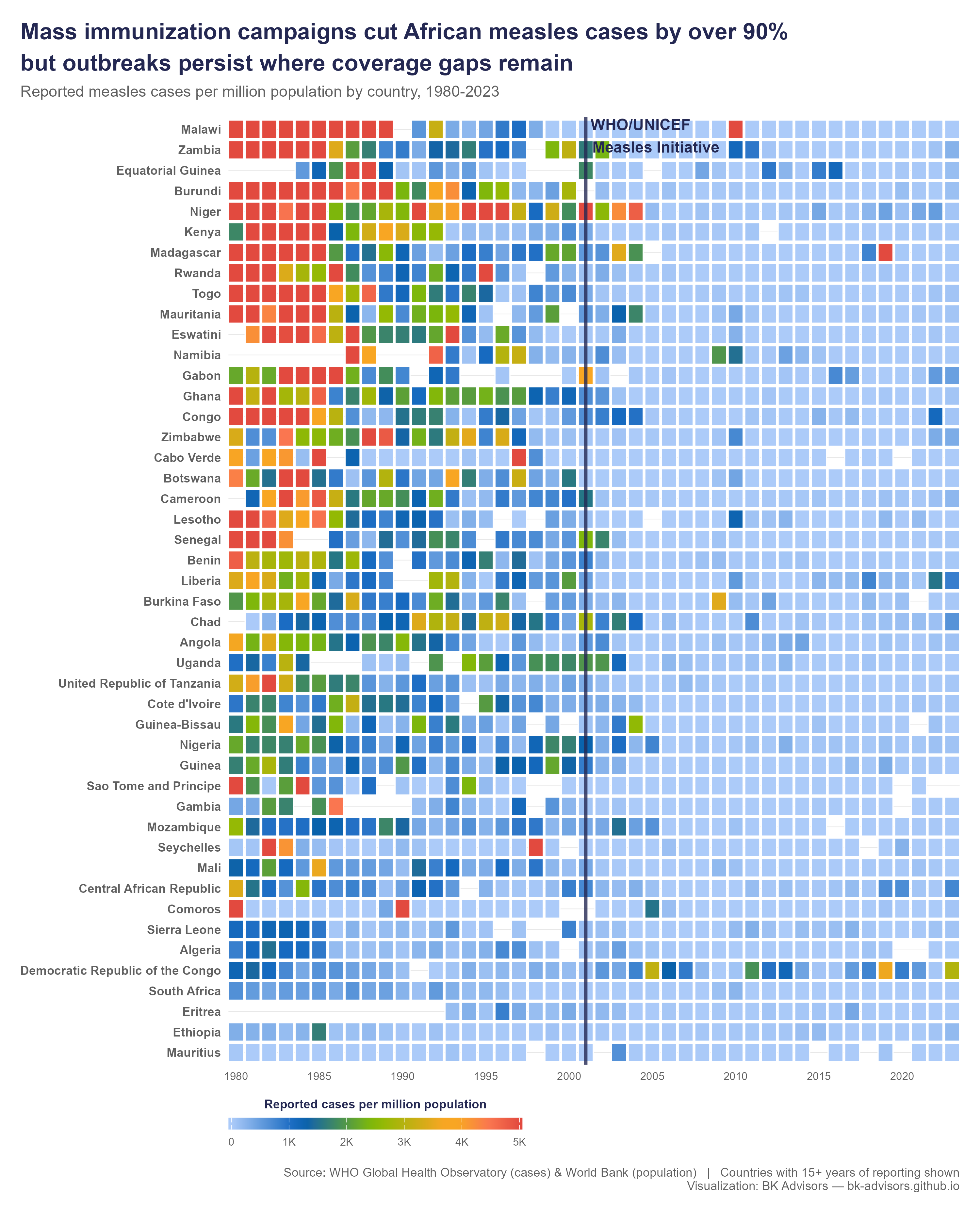
Countries that used to see thousands of cases per million people (e.g. Malawi, Zambia, Niger, Kenya) saw their numbers collapse within a few years.
It’s one of the most dramatic public health achievements of the last half century. But it’s hard to appreciate something you can no longer see.
That’s why I built this interactive heatmap. 44 years, 46 countries.
You can watch the red tiles fade to blue, country by country, year by year. It makes the invisible visible.
Explore the interactive heatmap →
Watch the film
Prefer to watch? Here is a narrated film of the story, including what happened after 2016.
The narration is an AI voice (Google Gemini).
Notes and Sources
- Data: reported measles cases from the World Health Organization’s Global Health Observatory, and population from the World Bank. 46 African countries, 1980 to 2023. The heatmap shows the countries with at least 15 years of reporting.
- These are reported cases, so they depend on how well each country’s surveillance worked in a given year. The true number of infections was higher.
- Much of the fall came in two waves. Reported cases had already fallen from 1.4 million in 1981 to about 490,000 in 2001, as routine childhood immunisation spread in the 1980s. After the Measles Initiative’s campaigns began in 2001, they fell a further 93% to 35,371 in 2016.
- The gains are not permanent. Reported cases rose again to 615,194 in 2019 and were 416,476 in 2023, as outbreaks returned where vaccination coverage had slipped.
- The data and code are on GitHub. First posted on LinkedIn in March 2026.